
A 2-Hour Inspection, Then 2–3× That Time Writing the Report
In U.S. real estate transactions, home inspection provides comprehensive assessment of property conditions. Home inspectors document current conditions and organize field observations into detailed reports, serving as critical documentation for fair and safe transactions.
After interviewing over 10 home inspectors, we found that writing and organizing the report after fieldwork takes up a large part of their time.
On-site inspection takes approximately 2 hours, and inspectors often spend 2–3 times longer back at the office organizing photos, categorizing items, and writing property condition descriptions.
Reports Must Be Neutral. AI Can't Make Professional Judgments
Inspection reports emphasize "problem discovery" rather than "providing guarantees." They must remain neutral and objective, avoiding overstated causes, damage predictions, or subjective assessments. Despite AI's strong generation capabilities, it cannot replace inspector expertise.
The home inspection industry is traditionally entrenched, with established tool use and work habits carrying high switching costs. We needed AI to enhance efficiency through integration rather than disruption.
These boundaries establish inspector confidence in AI, enabling real-world workplace adoption.
AI Defers to Expertise
Damage severity assessment remains the inspector's call. AI assists with organization and generation only.
Controllable Output
Inspectors can quickly review, edit, and correct all AI-generated content.
Fit Into Existing Workflows
No disruption to field pace, and no added tool-switching overhead.
Position AI as an Office Secretary, Organizing in the Background
We positioned AI as an "office secretary." Inspectors photograph and briefly note findings at their natural pace; AI captures those materials and organizes them into a usable report draft. In other words, when field inspection concludes, the report is nearly complete.

Three Core Features
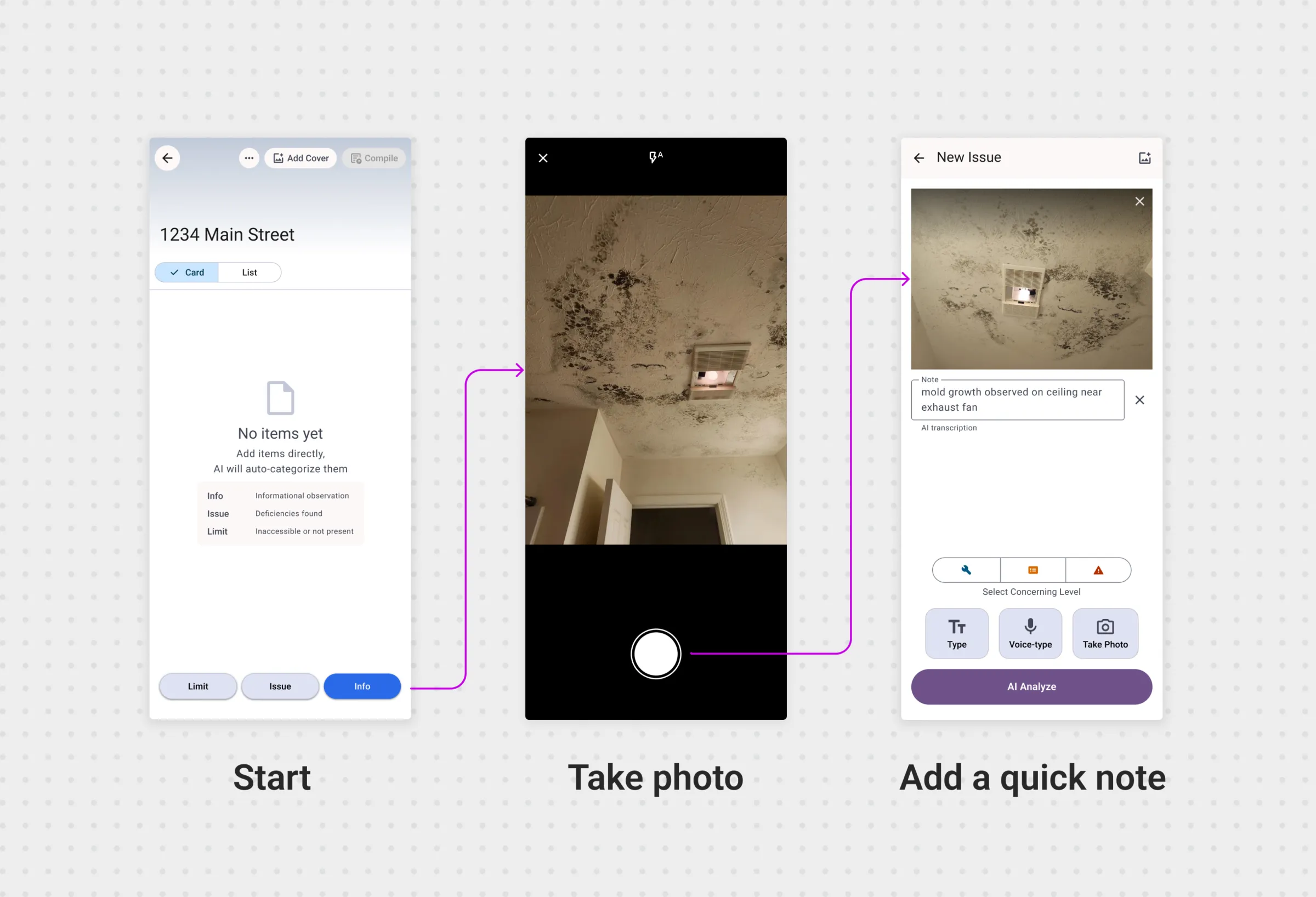
Photo-First Workflow
Inspectors need to move quickly through a property, covering every corner in limited time. When something catches their eye, the first instinct is to reach for the phone and take a photo.
So we designed the flow around photography as the entry point, with text notes or voice transcription as optional supplements rather than required steps, keeping the recording process in step with how inspectors actually work on-site.
Controllable Generation
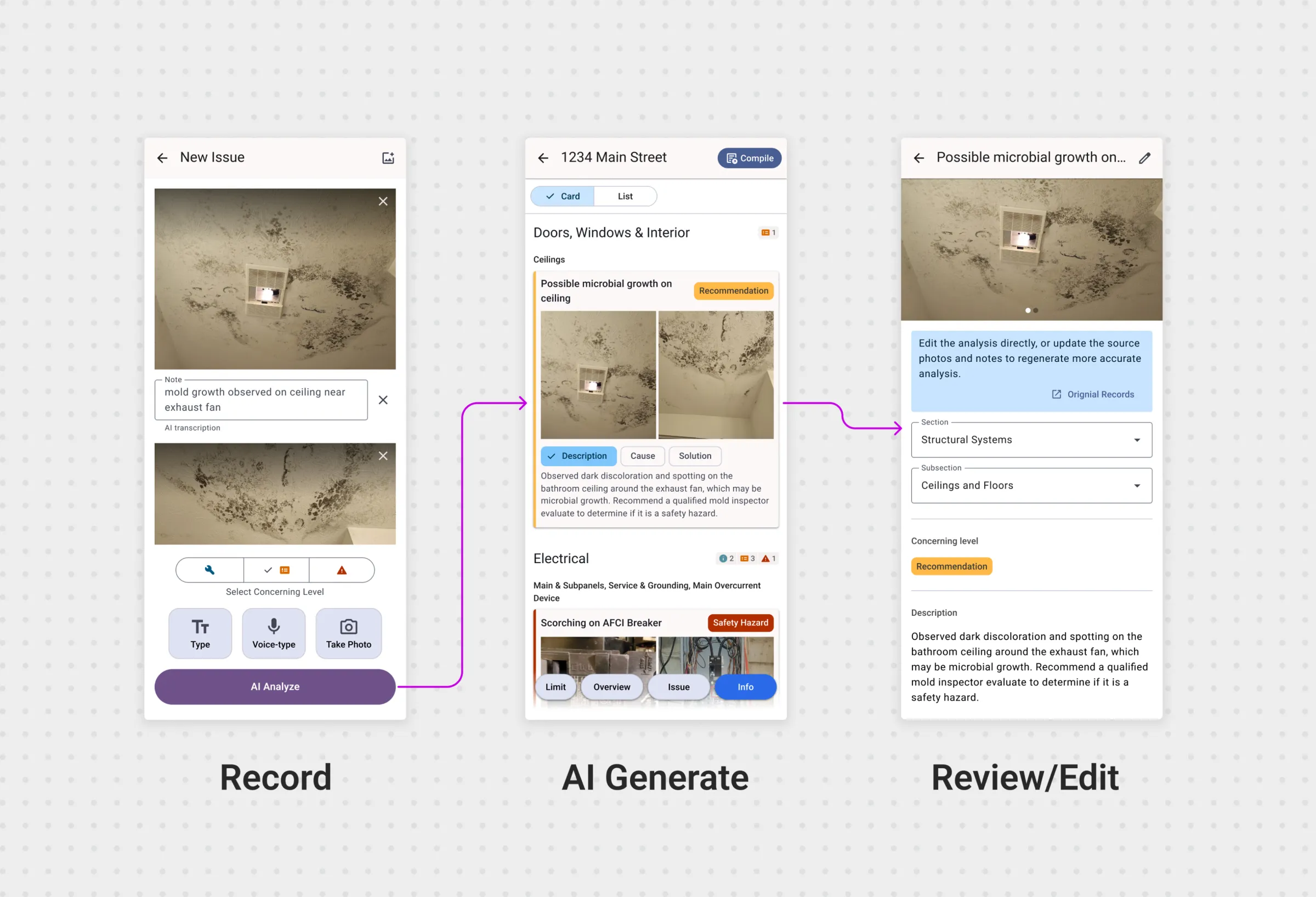
Inspectors select the damage severity level; AI generates a description based on photos, annotations, and notes. Inspectors can quickly review and edit the result.
The core design principle is that AI never determines severity on its own, preventing overestimation and descriptions that don't reflect field conditions, so that report content always rests on the inspector's professional judgment.
Automatic Categorization
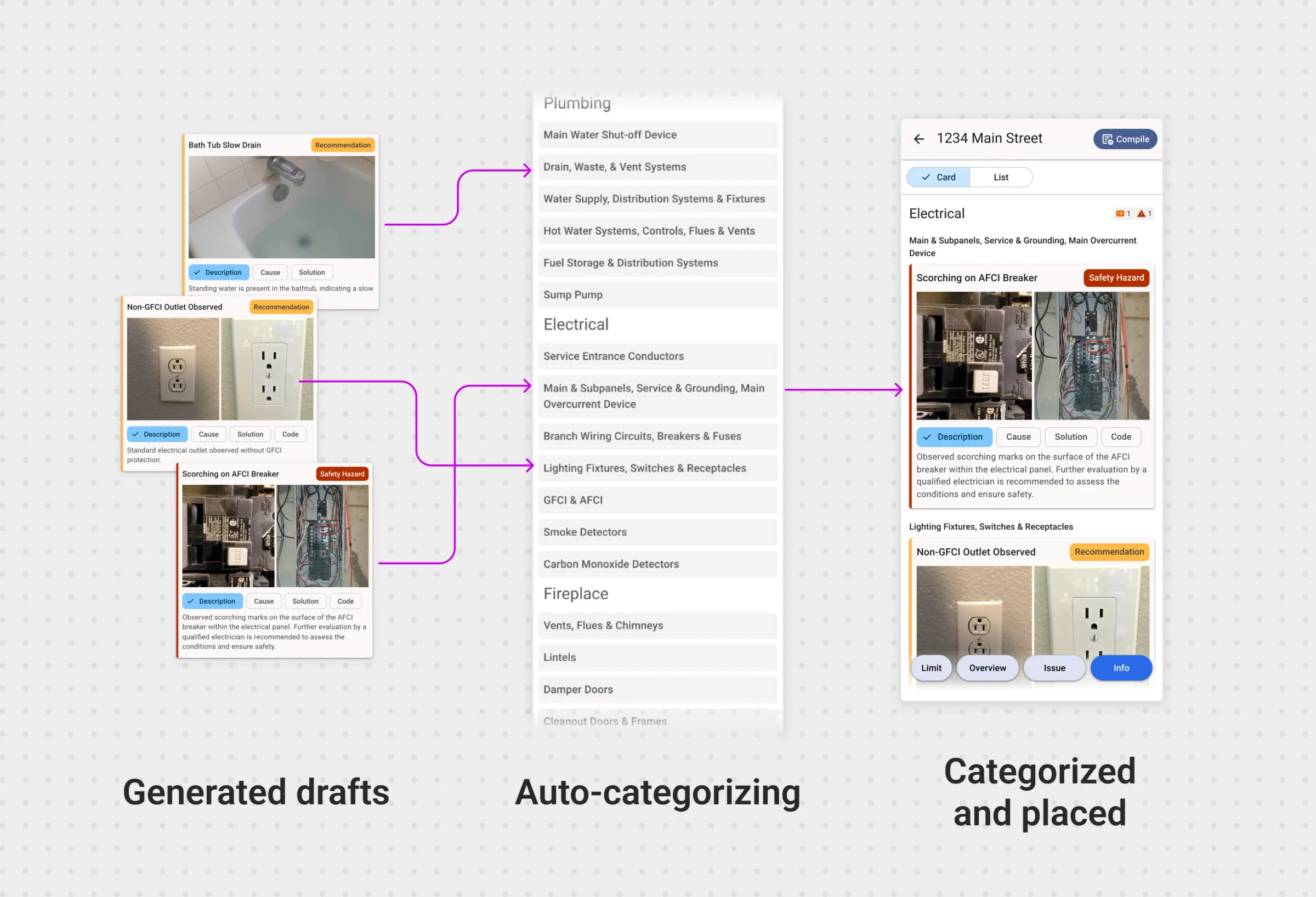
An inspector's path through a property doesn't follow the report's chapter order. They might start in the basement, head upstairs, then finish outside.
AI automatically files each item into the corresponding report section, eliminating post-inspection sorting. Inspectors can stay focused on finding issues rather than thinking about where each note belongs.
No Template Library. Personal Style Builds Itself
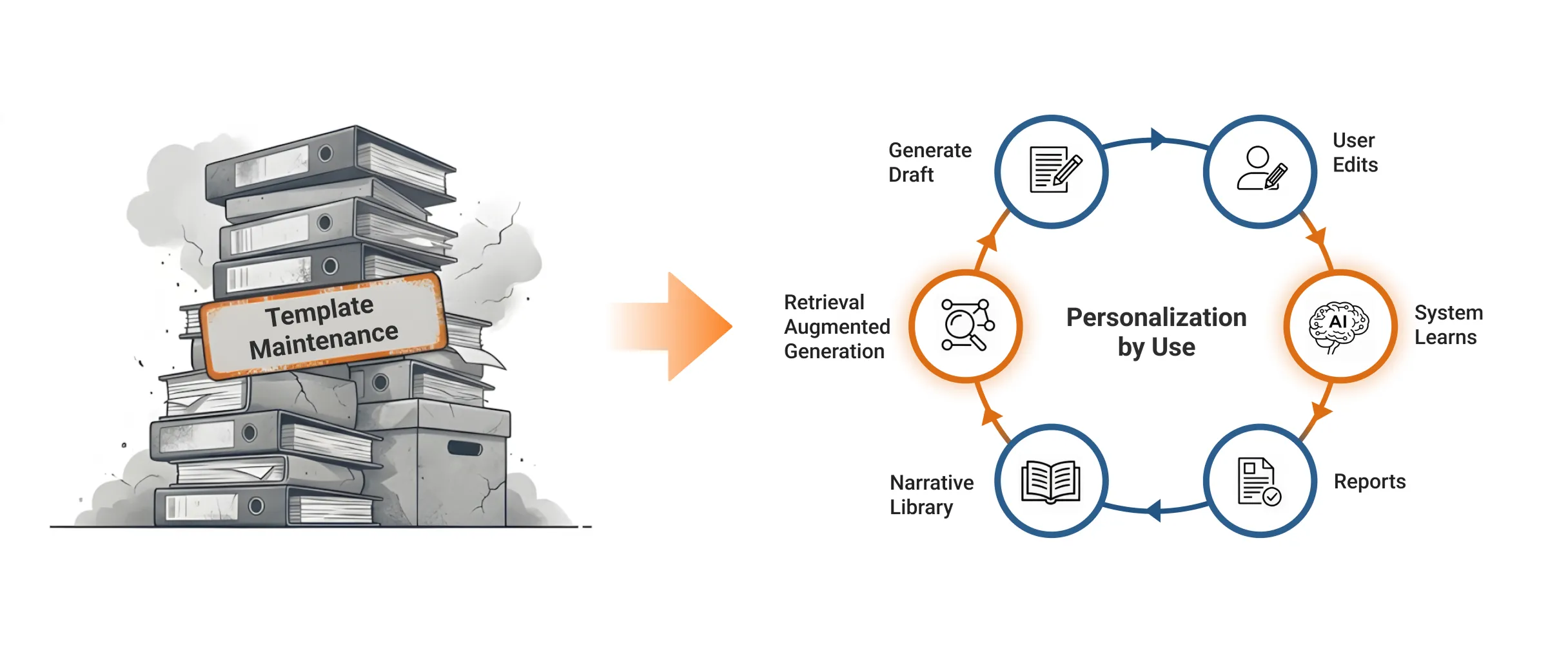
Traditional reporting tools rely on template libraries. Inspectors select descriptions and fine-tune text, but libraries require ongoing maintenance, grow unwieldy over time, and end up becoming a burden.
We shifted from "template maintenance" to "natural accumulation." Inspectors upload past reports as reference material; AI retrieves stylistically similar passages from them and combines those with current photos and notes to generate descriptions (RAG). Each manual edit feeds back into the system, gradually shaping output toward personal style, without any extra maintenance effort.
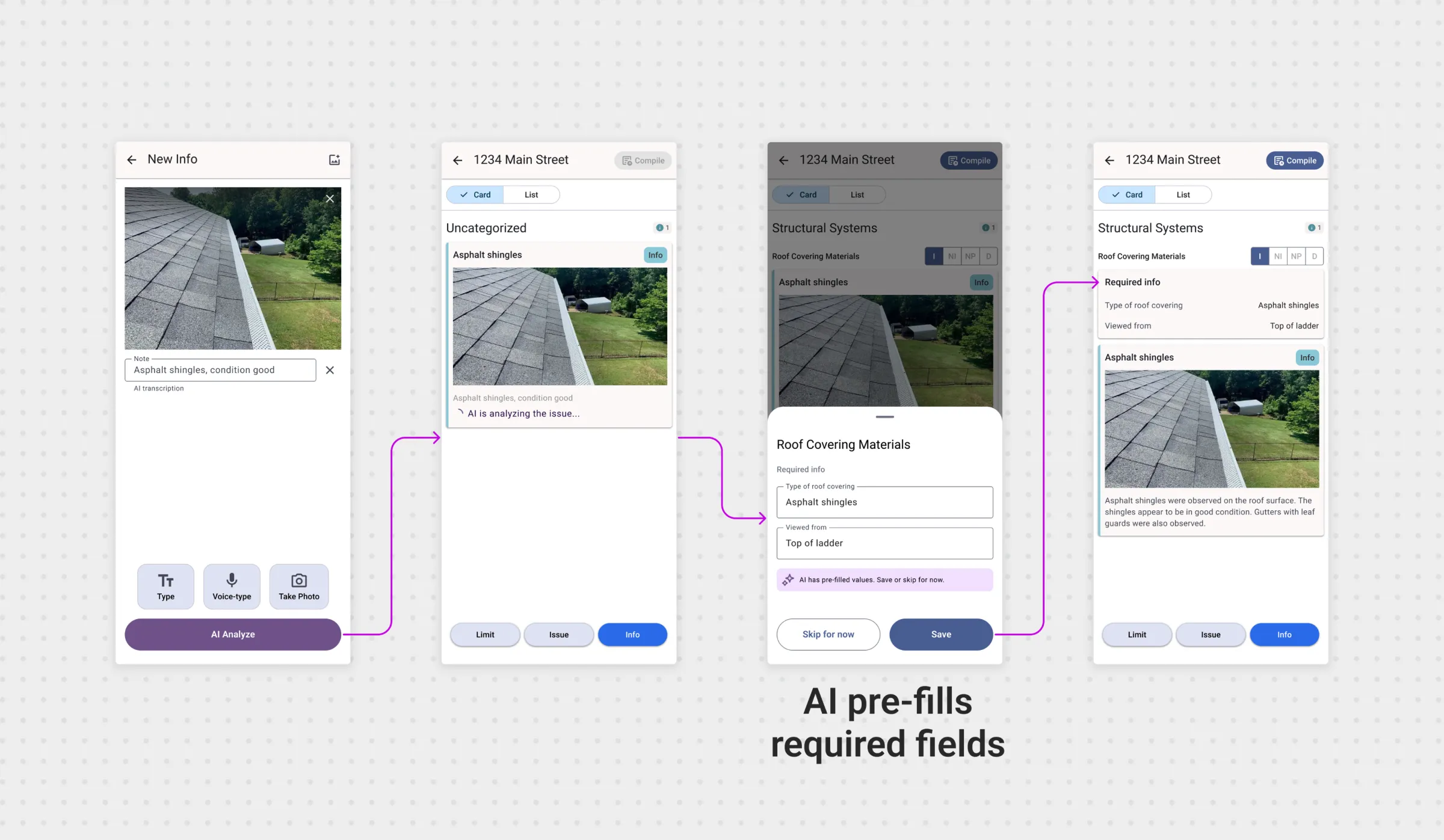
Extension Design: AI Pre-Fills Fields to Reduce Omissions
Some states and regions require specific report formats with mandatory fields. Omissions during field inspection often mean additional time spent confirming and completing data afterward.
Since AI already understands record content and completes organization, I proposed having AI pre-fill mandatory fields after organizing content, with inspector confirmation. This allows data completion as part of the natural workflow, integrating AI even more seamlessly into the inspection process. (concept)
Results: Market Validation, Trade Show Traction, Partnership Opportunities
Operating with a part-time team across time zones, we used rapid iteration and asynchronous collaboration to advance development and bring the product to market for validation, earning positive feedback.
- 2025 Q2: V1 official launch
- 2025 Q4: Attended InterNACHI convention, received attention from 30+ inspectors
- 2026 Q1: Began partnering with U.S. local government agencies
- Roadmap: Offline mode, regulation lookup, CRM integration, web-based report editing, and more

Reflection: Rethinking AI's Role in Professional Tools
At first I thought AI would transform home inspection in some novel, disruptive way. What actually proved more workable and more valuable was letting AI fit into the existing workflow with minimal disruption, leaving judgment to the inspector so they can stay focused on the inspection itself.
Amplify Expertise
Inspectors retain judgment authority while AI handles the tedious organization work.
Work With Existing Habits
Inspectors keep their existing workflow, with no new tool to learn or adapt to, and stay focused on their own expertise.
Trust First
Controllable, correctable generated content builds the confidence inspectors need to adopt AI in real work.